
Murphy Criminal History Checks
Begin with the Murphy event, not just a person’s name. The official custodian changes as a Murphy matter moves from a Murphy police report to a Murphy booking and then to court. A statewide repository record is yet another product. North Carolina does not offer the general public an unrestricted SBI name-search portal. The free eCourts Portal can reveal Murphy docket leads, but the Clerk of Superior Court remains the source for official Murphy files and the county name search.
Use this five-part route when the facts are not yet clear:
- Call Murphy Police at 828-837-2214 when MPD created the incident or arrest report. Ask where and how to submit a precise records request.
- For current Murphy custody or a county booking, call Cherokee County Detention at 828-837-2521. Do not treat a Murphy booking as a court result.
- Search the North Carolina eCourts Portal by party or case number, select Cherokee County, and use criminal case filters. Then verify the Murphy result with the Clerk.
- Request an official or certified Murphy court copy from the Cherokee County Clerk of Superior Court at 75 Peachtree Street or 828-835-7740.
- For your own fingerprint-supported North Carolina history, use the SBI Right to Review process. The public clerk search and personal SBI review serve different purposes.
Murphy Police Record Directory
The Town of Murphy directory is the verified online starting point for police contact. It lists the department at 828-837-2214 and identifies Chief Tim Lominac, Assistant Chief Ryan Cunningham, and Administrative Assistant Jon Avery in their public roles. The research did not confirm a dedicated records line, records email, counter address, fee schedule, or walk-in hours. Call before traveling and ask which staff member currently receives public-record requests.
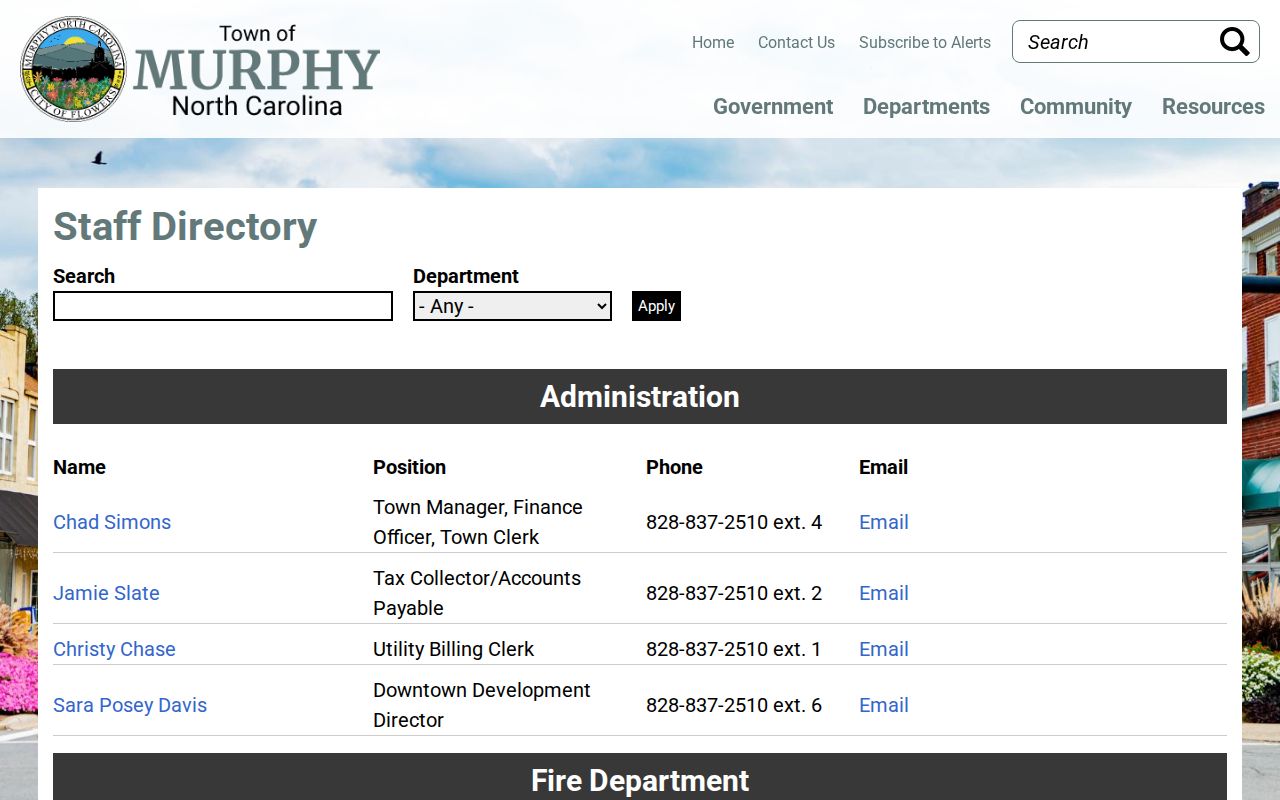
The Murphy directory capture matters because it shows the town’s real contact route without turning Murphy Town Hall into an unverified police-records counter. Murphy Town Hall is listed at 5 Wofford Street with a general number of 828-837-2510, but the research does not establish that Murphy location as the place to collect an MPD report.
Records at Murphy Police
Murphy Police owns the Murphy incident or arrest report created by its officers. That Murphy report can describe the event, alleged violation, officer response, and arrest circumstances. It is separate from the Murphy detention center’s intake data and the Clerk’s prosecution file. A Murphy requester should give the event date and approximate time, Murphy location, report number if known, people involved, and the exact material sought. Ask whether Murphy inspection, electronic delivery, or paper copy is available, then confirm any current charge before ordering.
North Carolina General Statutes 132-1.4 draws the key line for Murphy records. The full Murphy investigative or intelligence file is not public as a whole, but specific Murphy incident and arrest facts remain public. Those facts can include the time, date, location, and nature of the apparent violation; identifying details and alleged violation for a person arrested or charged; circumstances of the arrest; weapons, resistance, pursuit, or seized-item descriptions; and specified Murphy officer information. When a narrative is withheld, ask for those statutory facts instead of assuming the whole Murphy record is closed.
Murphy Police Request Gaps
The Murphy document library contains police material, but no active Murphy report-request form or vendor portal was verified there. No official Murphy blotter, police app, report fee, response promise, or records-unit schedule was found either. These Murphy gaps call for a direct phone request, not a borrowed process from a different city named Murphy or another Cherokee County. Ask MPD to confirm the current Murphy counter, cost, identity requirement, delivery method, and likely processing time.
A narrow Murphy request usually works better than a demand for an entire file. State whether you seek the public Murphy incident facts, arrest facts, a report copy, photographs, or another named item. County E-911 may hold Murphy call or dispatch material, while the detention center holds Murphy booking data. Body-camera and dashboard-camera recordings follow the special disclosure and release procedure in G.S. 132-1.4A; they are not ordinary Murphy report attachments that a Chapter 132 letter automatically produces.
Booking and Arrest Records in Murphy
When Murphy booking applies, MPD transports the arrested person to Cherokee County Detention at 577 Regal Street in Murphy. Murphy detention staff create intake and custody records, which can include booking identifiers, intake time, alleged charges, property, a photograph and fingerprints as applicable, classification, housing, and release status. Murphy medical screening and classification details are not presumed public. A magistrate or other judicial official handles Murphy process and release conditions without unnecessary delay, but the research supports no blanket promise that all Murphy cases appear within an exact number of hours.
The county website exposes an “In Custody” route for Murphy bookings, yet no stable public roster interface or reliable field list was verified. The safe Murphy fallback is the detention information line, 828-837-2521, or a focused Chapter 132 request. For the complete channel sequence and the limits of recent Murphy booking data, use the Cherokee County Arrest Search. NCDAC’s Offender Public Information Search covers state prison and supervision, not the Murphy county jail.
Who Holds Murphy Incident Records
Murphy sits where U.S. 19, 74, and 129 converge, so the Murphy town name alone does not identify the custodian. MPD may create one Murphy report, the Cherokee County Sheriff another, and the North Carolina State Highway Patrol another. A county E-911 record tied to Murphy can also sit with a different office. First identify the agency named on the Murphy citation, exchange slip, incident number, or court event. Then send each Murphy request to that office.
| Murphy record | First official channel | Limit or fallback |
|---|---|---|
| MPD incident or arrest report | Murphy Police, 828-837-2214 | Confirm the physical records counter and current fee. |
| Sheriff-created report | Sheriff, 577 Regal Street, 828-837-2589 | Do not redirect it to MPD merely because it occurred in town. |
| Current booking | Detention, 577 Regal Street, 828-837-2521 | Custody data is not the police narrative or court outcome. |
| SHP-investigated crash | Official Highway Patrol collision search | The portal covers SHP crashes since May 16, 2013, not every town collision. |
The Murphy Municipal Court File
There is no Murphy municipal court and no Murphy town judge or municipal case portal. North Carolina uses a unified state court system. District Court at the Cherokee County Courthouse handles Murphy misdemeanors, infractions, town ordinance matters, and early felony proceedings. Superior Court handles felony trials. One Clerk of Superior Court keeps both sets of official Murphy files. Searching for a Murphy town court therefore sends the reader toward an office that does not exist.
| Court Name | Cherokee County District Court and Superior Court, part of the North Carolina Judicial Branch. |
|---|---|
| Case Types Heard | District Court hears misdemeanors, infractions, ordinance matters, and initial felony stages; Superior Court tries felonies. |
| Case Lookup Channel | Free North Carolina eCourts Portal for public docket leads, followed by the Cherokee Clerk for the official record. |
| What the Docket Shows | Public case summary, parties, events, hearings, dispositions, judgment details, and financial information when available. |
| Copies & Fees | The Clerk supplies official or certified copies and offers a $25 county public-record name search; confirm copy charges. |
The courthouse is at 75 Peachtree Street, Murphy, and the Clerk’s phone is 828-835-7740. Public hours are Monday through Friday, 8:00 a.m. to 12:30 p.m. and 1:30 p.m. to 5:00 p.m. The midday closure is important for anyone planning a counter visit.
Murphy Court Records in Blue Marble
The official Cherokee County history places Murphy as county seat from the county's 1839 formation. The working records counter stands in a Classical Revival courthouse built with locally quarried blue marble. A fire destroyed the prior brick courthouse on January 16, 1926. The present building opened in 1927, was designed by James J. Baldwin, and entered the National Register of Historic Places in 1979. The Census QuickFacts profile provides the current county population and geography context for this single records hub. Cherokee County reports four earlier courthouses, three of which burned.
This history explains more than the look of downtown Murphy. The Clerk still supplies official District and Superior Court records in that building, while the Sheriff and Detention Center keep law-enforcement and custody material at Regal Street. Those nearby offices hold different record families. The Clerk cannot produce an MPD investigative narrative, and detention staff cannot certify a judgment. Physical proximity does not merge custody, police, and court files.
How Murphy Records Reach the County
An MPD case can create several records on different schedules. The officer report begins with the town agency. Detention creates a booking when county intake occurs. A magistrate handles initial process and release conditions, and the Clerk creates the public court file as charges enter the system. Fingerprint-supported arrest information then reaches the North Carolina State Bureau of Investigation, with a later court disposition reported for linkage to that arrest cycle.
Record flow: Murphy Police Department › Cherokee County Courts › North Carolina State Bureau of Investigation
A same-day eCourts search can be too early. Search by party or case number, select Cherokee County, and review events separately from dispositions. If the allegation is a felony, District Court handles the early stages before a possible Superior Court trial. For an authoritative copy, an older file, or a matter not viewable online, contact the Clerk. SBI's background-check FAQ explains how a subject challenges repository information after obtaining a personal review. A dismissal on the docket does not by itself erase MPD or booking references; expunction is a separate legal process.
Murphy Case Records by Court
Charge labels can shift between the street event and the final judgment. An arrest label states what was alleged at one point. The prosecutor may amend, dismiss, or replace that charge. The disposition states how the court resolved it. Reading only the first label can produce a false account of a Murphy case.
- District Court
- The local trial court for misdemeanors, infractions, and ordinance matters, and the court for initial felony proceedings.
- Superior Court
- The felony trial court serving Cherokee County.
- Disposition
- The recorded result of a charge, such as conviction, dismissal, or acquittal.
- Arraignment
- The stage when the charge and plea are formally addressed.
- Expunction
- North Carolina’s statutory process for removing qualifying official entries, subject to narrow retained confidential files.
Portal results are useful leads, not certified records and not a statewide SBI rap sheet. If Smart Search returns no match, check spelling, wildcard rules, Cherokee County location, case status, and filing dates. A no-match screen may also reflect restricted or expunged material, a filing delay, or activity in nearby Georgia or Tennessee rather than proof that no record exists. A federal Murphy matter belongs to the Western District of North Carolina in Asheville; the U.S. Attorney's Asheville office is a prosecution contact, not the court clerk.
Murphy Record Access Rules
The North Carolina Public Records Law applies to town and county custodians, while separate statutes define what may be withheld. A person can inspect public records at reasonable times and request copies subject to lawful costs. Extensive requests may support a special service charge. Court files are open under the Clerk’s inspection authority unless another law seals or restricts the material.
Key Statutes:
North Carolina Public Records Law, Chapter 132 gives the public inspection and copy rights subject to lawful exceptions and fees.
G.S. 132-1.4 protects complete investigative files while making listed incident and arrest facts public.
G.S. 132-1.4A creates a distinct process for viewing or obtaining law-enforcement recordings.
G.S. 7A-109 opens Clerk records for inspection unless the law makes a category confidential or sealed.
Juvenile matters, victim identities, sensitive identifiers, medical data, sealed files, and expunged records are not treated like ordinary public dockets. Returned warrants, indictments, and criminal summons are generally public unless sealed. Ask the actual custodian to identify the rule supporting a denial and, when possible, request the segregable public fields rather than a protected whole file.
Murphy Address Registry Records
The official North Carolina Sex Offender Registry offers a separate safety search that can be centered on a Murphy street address. Users may search by address, city, ZIP code, name, county, status, registration number, or map location. Cherokee County appears as county value 020. Email alerts can report moves within one, three, or five miles of an address. Because Murphy lies near state borders, the federal National Sex Offender Public Website adds official cross-state coverage. If custody later moves to the federal system, the Bureau of Prisons locator replaces the county jail as the relevant custody search.
Registry data is not a full criminal history, and a name or photograph is not enough for positive identification. NCSBI warns that fingerprint comparison is the only sure identification method, some details are offender reported, and changes can occur quickly. Report a suspected registration or address problem to the Cherokee County Sheriff at 577 Regal Street or 828-837-2589. Registry information is for awareness and safety, never threats, stalking, intimidation, or harassment.