
Cherokee County Criminal History Checks
Start with the record that can answer the question. The free North Carolina eCourts Portal guidance explains how to locate public case entries, hearings, judgments, and dispositions. A result there is a docket lead. It is not a certified Cherokee County criminal record or a fingerprint rap sheet. The Clerk of Superior Court holds the official District and Superior Court files and can conduct a county name search. Current custody and booking questions go to Cherokee County Detention, while an incident report stays with the sheriff, Andrews Police, Murphy Police, or Highway Patrol agency that created it.
Gather a full name, spelling variants, an approximate filing or arrest date, and a case or citation number when one is known. Date of birth data can help distinguish similar names where the public interface permits it. Search narrowly before widening a query. Then compare case events with the disposition instead of treating the first charge label as the final result.
- Search eCourts by exact name or case number and set the location to Cherokee County.
- Open the case summary, then read events, hearings, charges, and dispositions as separate fields.
- Call the Clerk at 828-835-7740 for older files, official copies, certification, or a $25 county name search.
- Contact Detention or the arresting agency for recent custody, booking, and statutory arrest facts.
- Use the SBI Right to Review process when checking or correcting your own fingerprint-supported North Carolina history.
eCourts Fields for Cherokee Records
Smart Search supports more than a basic name box. It can use a party, record number, citation, attorney, business, cross-reference number, or nickname. Advanced filters narrow the results by Cherokee County, criminal case type, case status, and filing dates. Wildcards have minimum character rules, so a broad search entered too soon may fail or return a noisy list. An exact Cherokee County search first gives the best chance of matching the intended case.
| Control | Best use | Important limit |
|---|---|---|
| Search Type | Name, case, citation, attorney, or business | Select the matching kind of key |
| Location | Choose Cherokee County | Nearby Georgia or Tennessee cases will not appear |
| Case Type and Status | Narrow criminal and open or disposed cases | A filter can hide a relevant result |
| Filing Date | Limit the time span | New filings may take time to appear |
| Hearings and Judgments | Check schedules and outcomes | Portal data is not the certified file |
A “no cases match” message does not prove there is no Cherokee County criminal history. It may reflect spelling, formatting, an over-tight filter, a different county, processing lag, or a sealed or expunged matter.
Official Background Checks in North Carolina
The North Carolina State Bureau of Investigation Criminal Information and Identification Section does not offer the public an unrestricted statewide name-search portal. A person may request their own fingerprint-supported North Carolina Criminal History Record Information through the SBI Right to Review. The $14 request requires a complete ten-print card, a completed packet, and certified check or money order. It covers North Carolina arrest events and linked dispositions received by SBI. It does not stand in for a Cherokee County certified court file or an FBI identity history.
The official SBI personal-review page shows the state’s subject-only route.
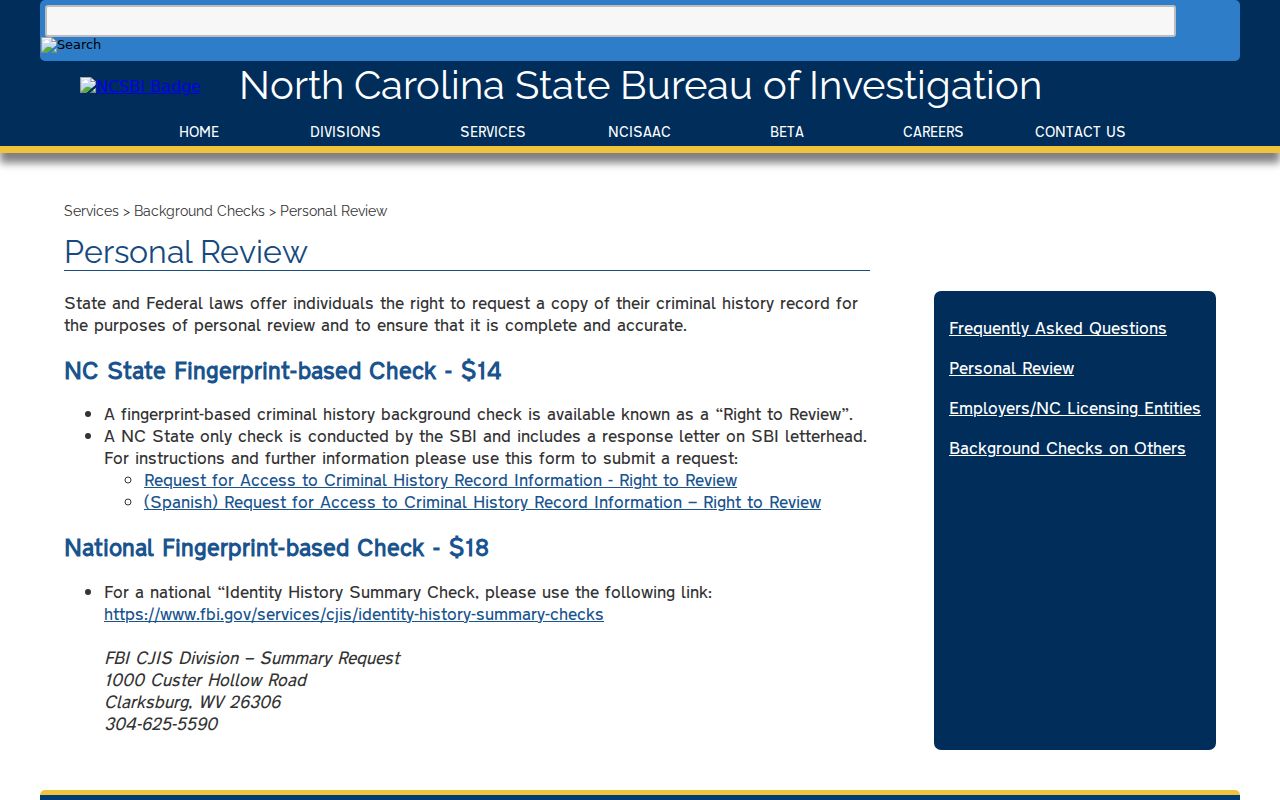
This route is built for reviewing and correcting one’s own fingerprint-supported state record, not for browsing other people by name.
| Official product | Base fee | Scope | Main limit |
|---|---|---|---|
| SBI Right to Review | $14 per copy | Subject’s fingerprint-supported NC history | Mail and prints; North Carolina only |
| Sheriff fingerprint service | $10 | Ten-print capture and card | It is not a record search |
| Cherokee Clerk name search | $25 | Public county court records searched | Name based and court limited |
| eCourts Portal | Free | Public docket leads | Not official or certified |
| FBI Identity History Summary | $18 | Subject’s FBI-maintained history | Fingerprint and added capture costs may apply |
Cherokee County Criminal Records Offices
Cherokee County has two main physical records hubs in Murphy. The courthouse counter serves judicial files. The Sheriff’s Office and Detention Center serve sheriff reports, booking questions, and current county custody. They are not interchangeable. A clerk can certify a judgment but does not own an Andrews Police narrative. Detention can confirm a booking but cannot turn an arrest allegation into a conviction.
The Judicial Branch courthouse page publishes the split counter hours and accessibility information.
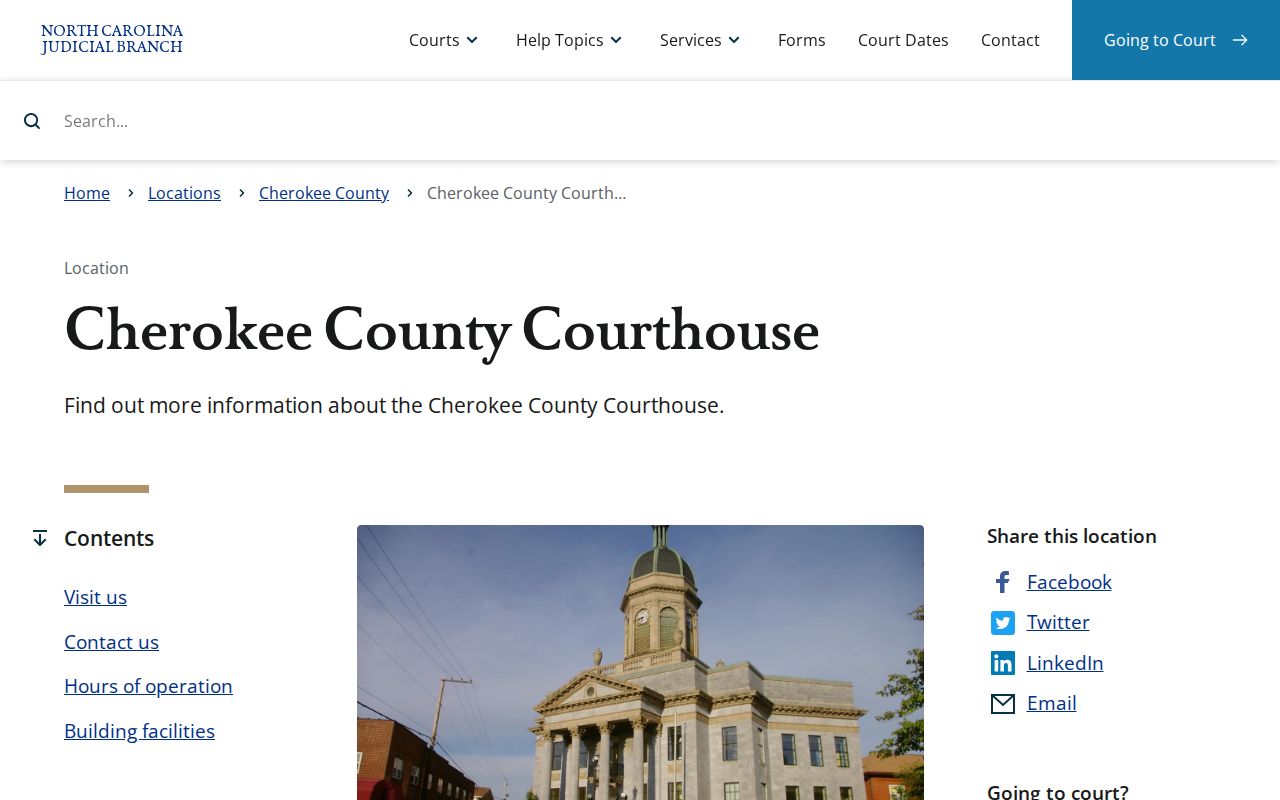
The midday closure from 12:30 to 1:30 p.m. matters when planning a long trip from an outlying part of Cherokee County.
Cherokee Clerk of Superior Court
75 Peachtree Street
Murphy, NC 28906
828-835-7740
Weekdays 8:00 a.m.-12:30 p.m. and 1:30-5:00 p.m.
Sheriff and Detention
577 Regal Street
Murphy, NC 28906
828-837-2589
Detention information: 828-837-2521
Kinds of Criminal Records
A Cherokee County criminal history is not one file. An agency report describes an event and an officer’s action. Detention creates the booking record. The clerk opens and maintains the prosecution file. SBI compiles fingerprint-supported arrest cycles and the dispositions it receives. NCDAC tracks state prison and supervision information. The NCSBI registry is a separate public-safety system created under Article 27A.
- Incident or arrest report: held by the sheriff, Andrews Police, Murphy Police, Highway Patrol, or other originating agency.
- Booking record: created at Cherokee County Detention during intake and custody processing.
- Court file: maintained by the Clerk for District and Superior Court charges, events, dispositions, and judgments.
- SBI CHRI: the subject’s fingerprint-linked statewide arrest cycles with reported outcomes.
- Custody or supervision record: split among the county jail, NCDAC, and federal Bureau of Prisons by jurisdiction.
- Registry record: public data entered by county sheriffs and maintained by NCSBI.
The source determines what a record proves. A booking proves intake, not guilt. A court disposition answers how a charge ended. A repository gap may mean SBI never received a qualifying fingerprint card or a matched outcome.
Cherokee County Fingerprint Record Route
The Cherokee County Sheriff fingerprint page documents public ten-print service at 577 Regal Street. The $10 service includes the card. It is available at any time, but an urgent law-enforcement need may require a person to return. Calling before travel can prevent a wasted trip.
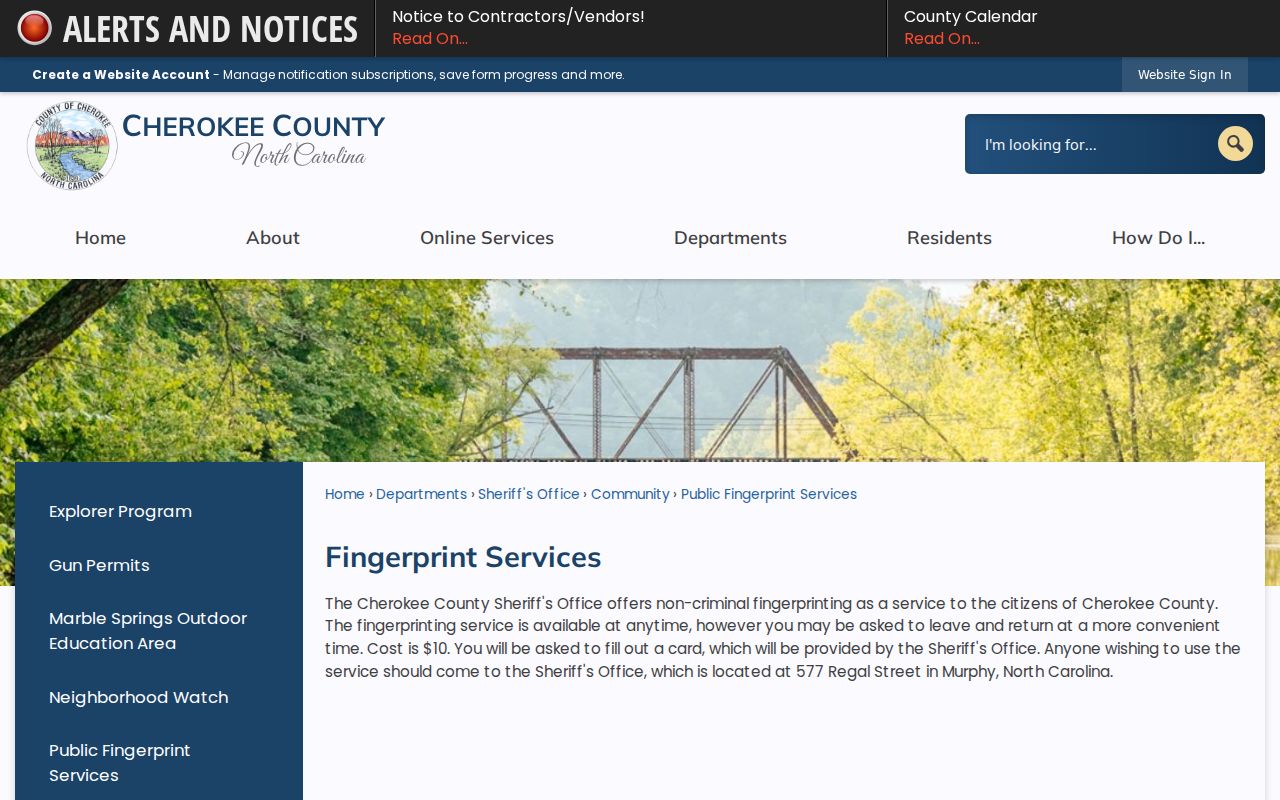
The card is one part of the SBI packet. The subject must still complete the Right-to-Review form, add accepted payment, and mail the request to the SBI Criminal Information and Identification Section.
If the returned record lacks a disposition or appears wrong, identify the challenged arrest cycle and contact the court or agency holding the corrected source. SBI’s written-exception process then handles the repository challenge. This keeps the court correction and the state criminal-history correction in their proper lanes.
Cherokee County Criminal Records: What They Contain
Public court details may include a case number, filing date, assignments, public parties and attorneys, charge entries, case events, hearings, dispositions, judgment information, and financial assessments. SBI CHRI instead begins with fingerprint-supported identity data and arrest cycles, then adds linked court outcomes when received. A Cherokee County booking file focuses on intake and current custody. Sensitive medical or classification data is not presumed public.
| Name and identifiers | Public name and available matching data; fingerprint identity is stronger than a name match. |
|---|---|
| Arrest and booking | Date, agency, alleged charge, intake details, and release or custody information when public. |
| Charges and events | Filed allegations, hearings, assignments, and the procedural history of the court matter. |
| Disposition | The result for each charge, such as conviction, acquittal, dismissal, or another recorded outcome. |
| Sentence | The judgment, punishment, restitution, and supervision terms shown in the official court file. |
| Custody or supervision | County detention, state prison, probation, parole, or post-release data held by the proper system. |
- Disposition
- The recorded outcome of a charge.
- Arraignment
- The stage when the charge and plea are formally addressed.
- Indictment
- A grand jury’s formal felony accusation, not a finding of guilt.
- Recognizance
- Release on a promise and conditions without secured money.
- Expunction
- Statutory removal of qualifying official entries, subject to limited confidential retention.
Cherokee County Warrant Records Need Care
Cherokee County publishes no complete public active-warrant database. The Sheriff’s Top Ten page is a curated list without search fields or comprehensive coverage. It cannot clear a person or confirm that no warrant exists.
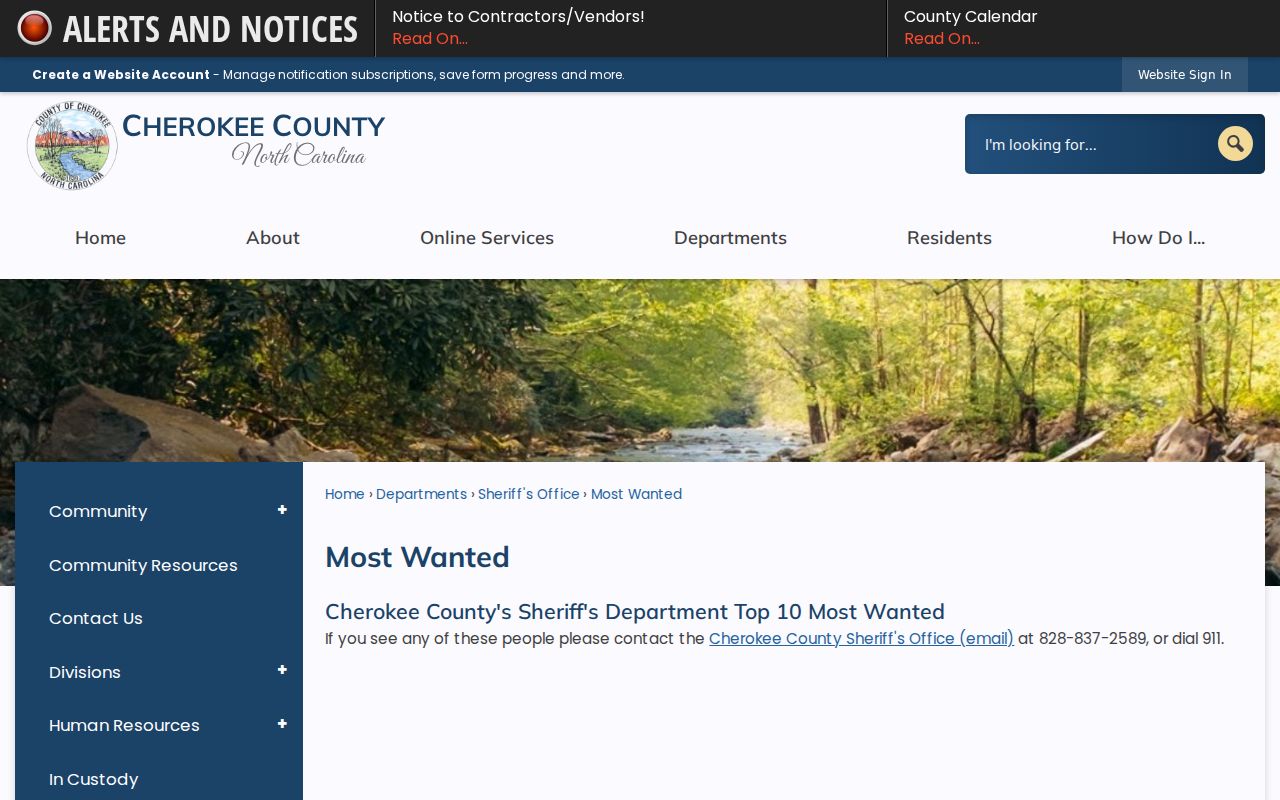
A sound Cherokee County warrant check uses several official contacts: Sheriff at 828-837-2589 for held or served process and logistics, Magistrates at 828-835-7755, and the Clerk at 828-835-7740 for court process or failure-to-appear events. eCourts may provide related case leads but is not authoritative warrant clearance.
Returned warrants are public unless sealed, while active search warrants, juvenile process, and sealed matters can be restricted. A focused Chapter 132 request can seek the public portion. Anyone resolving their own possible warrant should contact the proper office before appearing in person and should not rely on a missing web result.
North Carolina Public Access Laws
The North Carolina Public Records Law starts from public inspection, but it does not make each law-enforcement file fully open. G.S. 132-1.4 protects investigative and intelligence records while requiring listed incident and arrest facts. Clerk records are open under G.S. 7A-109, subject to sealed and confidential categories. Law-enforcement recordings follow a special disclosure and release process rather than the ordinary records-request route.
Key statutes:
G.S. 132-1 and 132-6 require reasonable inspection and copies as promptly as possible, subject to lawful fees.
G.S. 132-1.4 separates public arrest facts from protected investigative files.
G.S. 132-1.4A sets the distinct route for law-enforcement recordings.
G.S. 7A-109 governs public inspection of clerk records.
G.S. 15A-146 covers qualifying dismissal and not-guilty expunction relief.
When an agency withholds a full narrative, ask for the specific public facts listed in G.S. 132-1.4(c). A narrow request is more useful than demanding every investigative document at once.
Cherokee County Custody Records Split
The county “In Custody” route did not expose a stable public roster during research. For a recent Cherokee County booking, call Detention at 828-837-2521 or ask for public booking facts at 577 Regal Street. The Sheriff’s official page supplies the correct detention and records paths.
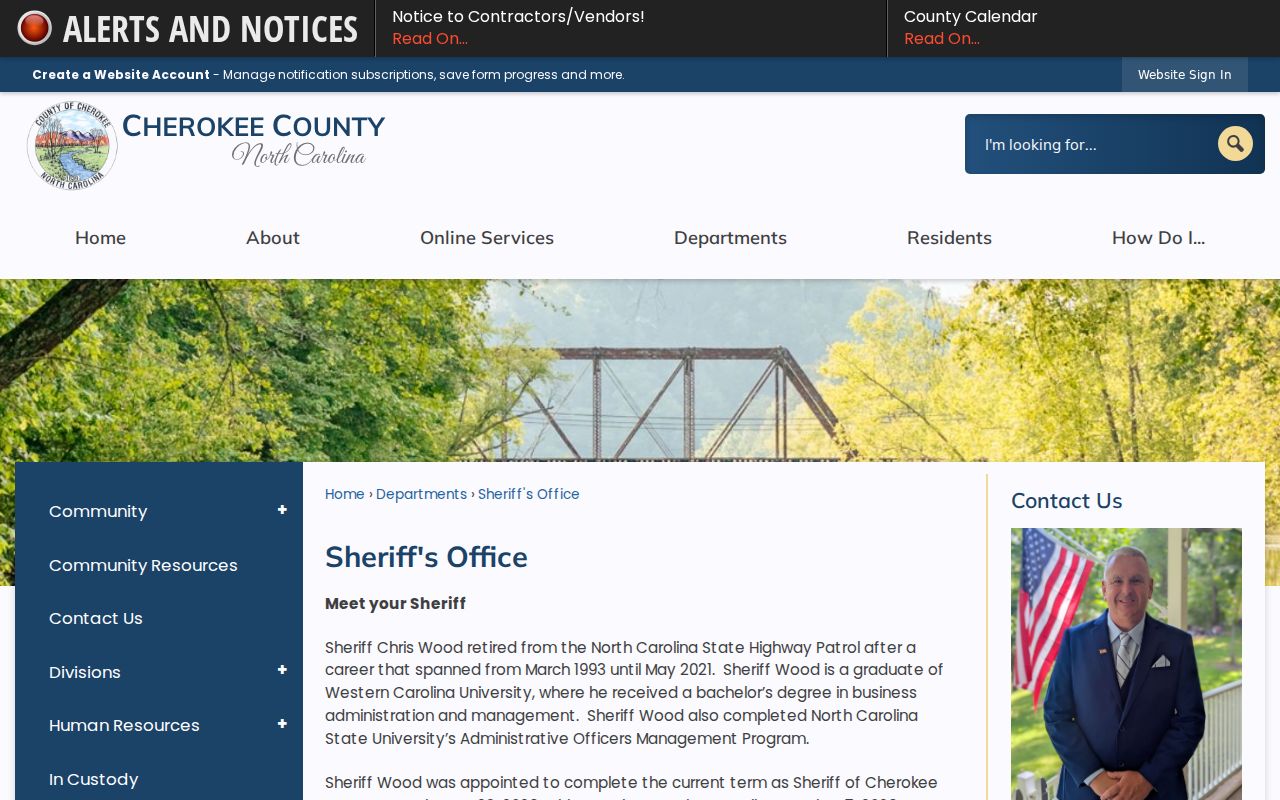
The Sheriff’s page is the county starting point, but it should not be confused with a verified daily booking blotter. No such official blotter was found.
After transfer to state custody or supervision, use the NCDAC criminal offender searches. That system covers state prison, probation, parole, post-release information, and historical records back to 1972. It excludes the Cherokee County jail.
The official state search illustrates that separate scope.
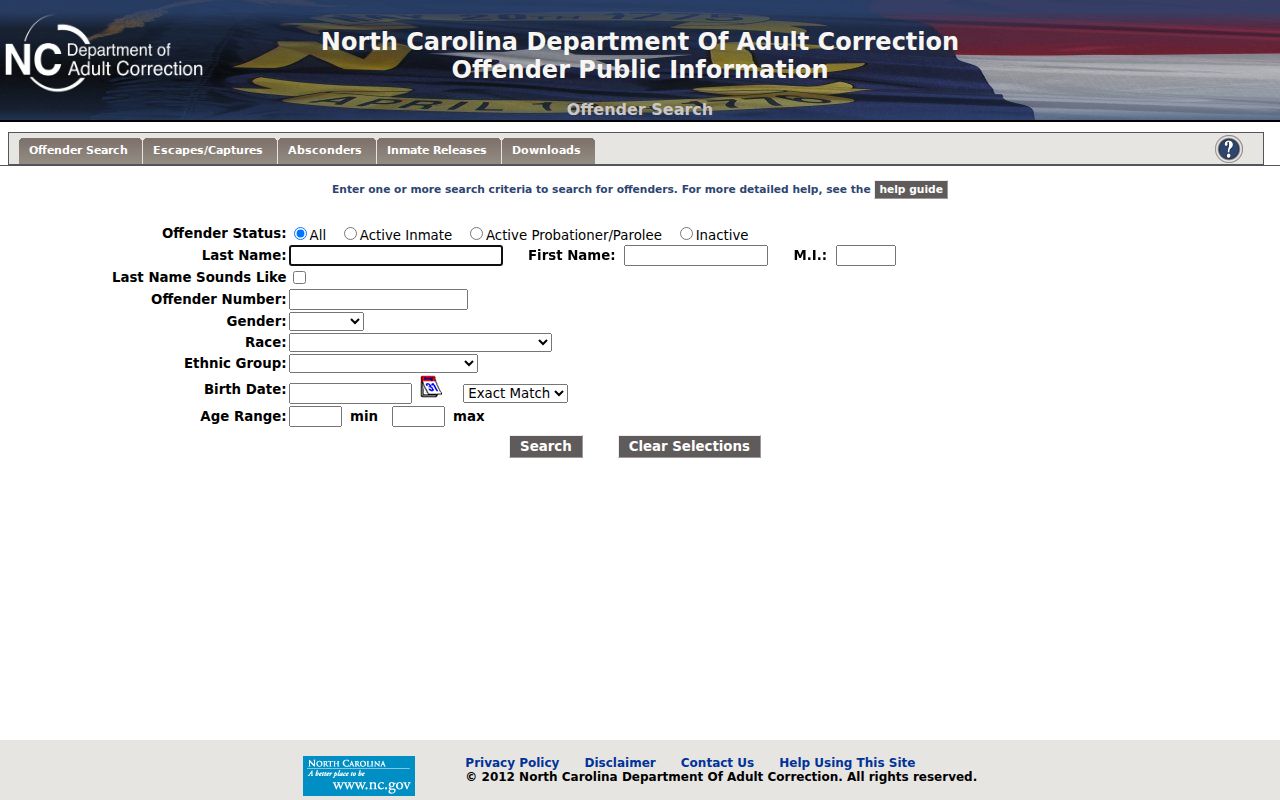
Federal custody requires the Bureau of Prisons locator, while NC SAVAN or VINELink is a notification aid rather than a complete criminal-history report.
Restricted, Sealed & Expunged Records
Juvenile matters, victim identities, sensitive personal identifiers, medical details, sealed cases, and expunged entries are not ordinary public eCourts material. A blank search result can therefore have several meanings. It should not be used to claim that an event never occurred. An arresting agency may also retain a related investigative file even when qualifying court and repository entries are removed by expunction.
North Carolina permits petition-based relief and some automatic relief. Qualifying charges ending wholly dismissed without leave or not guilty on or after December 1, 2021 may be expunged automatically 180 to 210 days after final disposition if statutory conditions are met. A felony dismissed as part of a plea deal is excluded from that automatic rule. Other petitions, including nonviolent convictions, have separate eligibility tests and waiting periods.
The North Carolina Judicial Branch expunction page provides current forms, filing guidance, fee information, and waiver material.
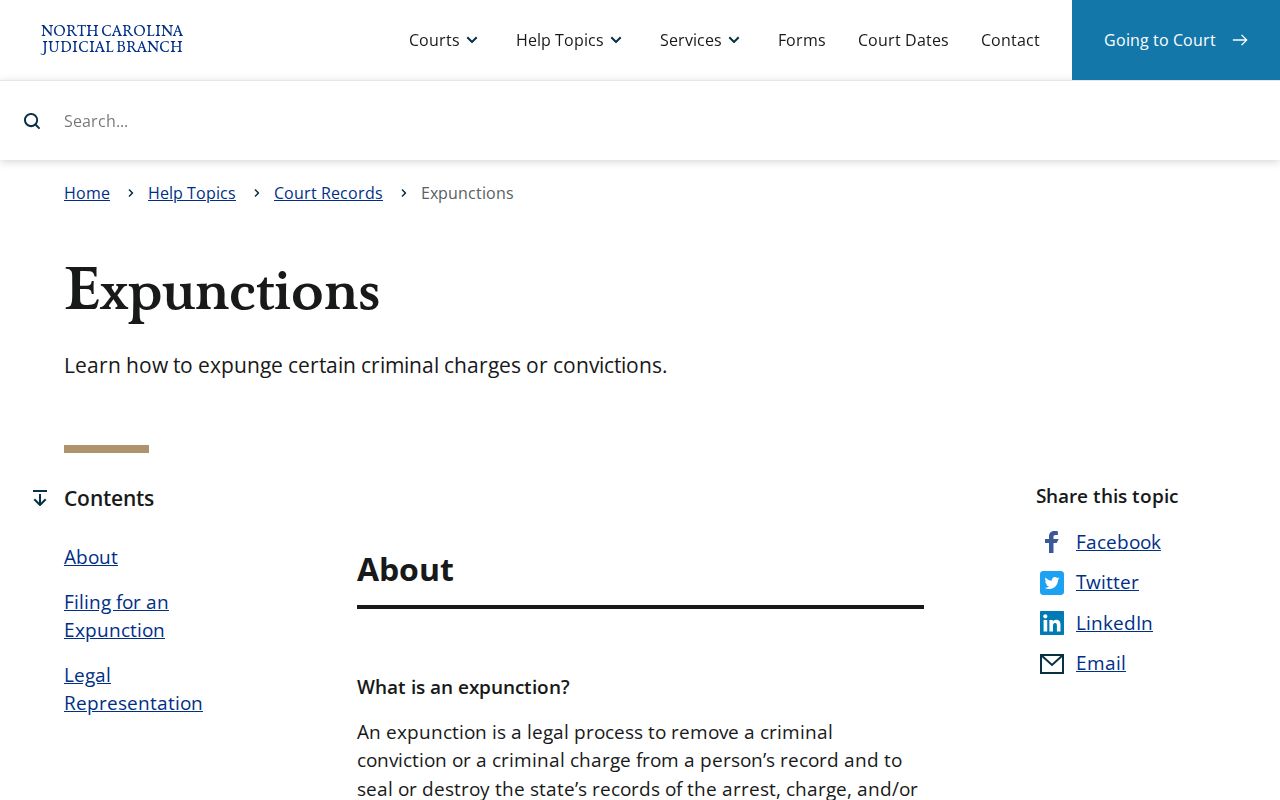
Petitions are filed with the Cherokee Clerk of Superior Court. The general petition fee is $175, with fee-free statutory categories and an indigency waiver; exact eligibility should be checked against the current form and statute.
Cherokee County Booking-to-Disposition Records
A single event can create records on different schedules. The arresting agency writes its report. Cherokee County Detention creates intake and custody data. A magistrate handles process and release conditions. The clerk creates the court file after the matter is entered. Fingerprint-supported arrest data reaches SBI, while the final disposition may arrive later. A same-day search can thus show custody before a public court case appears.
Record flow: Agency report › Cherokee County booking › District or Superior Court case › reported disposition › SBI criminal-history update.
Each step answers a different question. The arrest charge may be amended or dismissed. Read case events apart from dispositions. If an SBI personal review remains wrong, first obtain the court or agency source that shows the correction, then use the written-exception route with SBI.
Note: An arrest, a booking photograph, or a pending charge is not proof of guilt or a criminal conviction.
City-by-City Criminal Records in Cherokee County
Cherokee County has two incorporated towns. Andrews Police and Murphy Police each own the reports their officers create, while county Detention holds bookings and the unified state court system handles town criminal cases. Neither town has a municipal court. The city pages keep those local routes distinct and explain when a reader must move from a police contact to Cherokee County or North Carolina records.
Andrews Record Check
2020 population 1,667. Start with Andrews Police for its report, then use county detention and courts.
Murphy Record Check
2020 population 1,608. Town police, the county courthouse, and detention hold separate record families.
Cherokee County Criminal Records History
The same courthouse that supplies official Cherokee County case records is part of the county’s civic history. A fire destroyed the prior brick courthouse in January 1926. The present Classical Revival building opened in 1927 with an exterior made from locally quarried blue marble. It joined the National Register of Historic Places in 1979. Cherokee County reports that three of its earlier courthouses burned.
The county’s historical courthouse page documents the building and provides its official photograph.
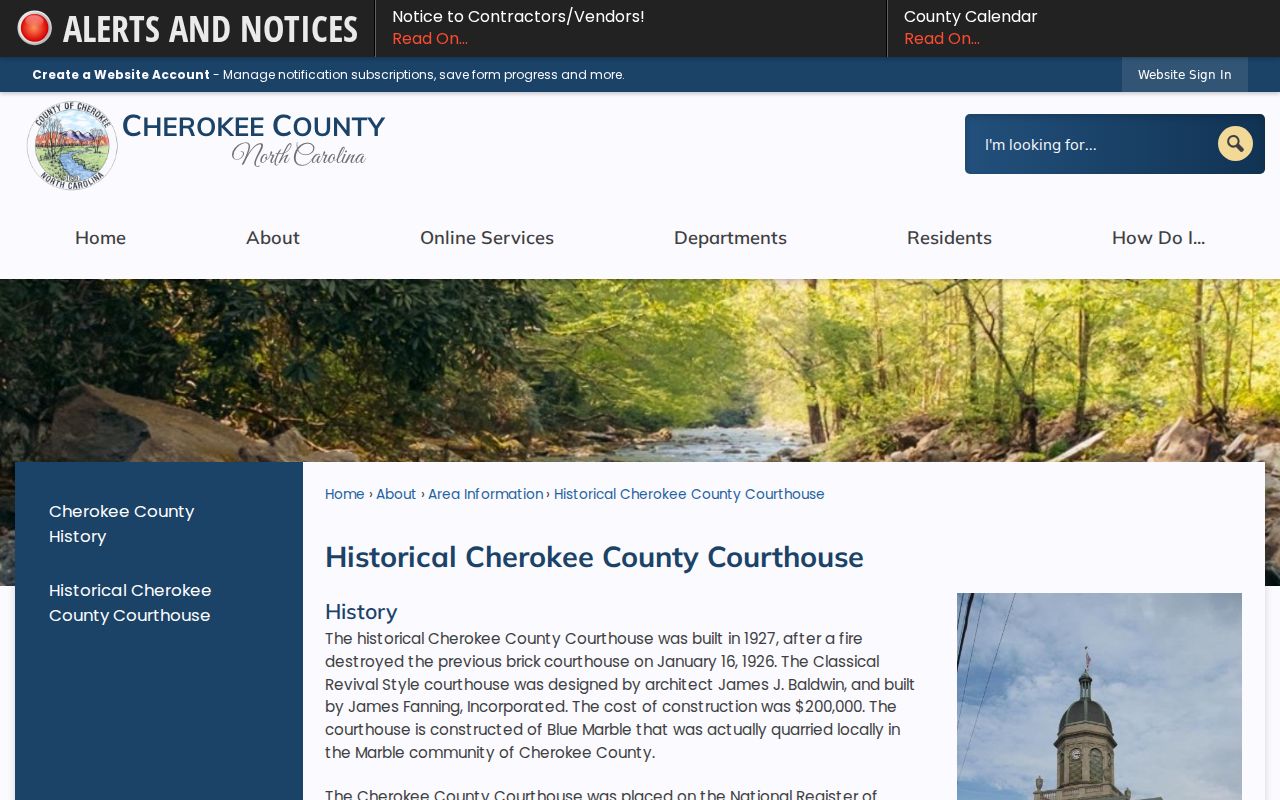
The landmark is not just local color. Its clerk’s counter remains the place for certified District and Superior Court records, the $25 county name search, and files that cannot be resolved through eCourts.