
Criminal Court Cases in Cherokee County
The Judicial Branch Cherokee County court page identifies one state courthouse for both trial levels. District Court hears misdemeanors, infractions, ordinance matters, and the first stages of felony cases. Superior Court tries felonies. The Clerk of Superior Court maintains the official files for both, so there is no separate county-created municipal court docket to search in Andrews or Murphy. Cherokee County belongs to Prosecutorial District 43, Superior Court District 43A, and District Court District 43.
The court file begins after legal process or charges are filed. It may change in ways the arrest record does not: a charge can be amended, dismissed, combined, or resolved under a different count. The filed disposition, not the booking label, shows the judicial outcome. Readers comparing the court file with the earlier custody event can review the distinct channels in the Cherokee County arrest search.
Which Cherokee County Court Hears It
A felony may first appear in District Court for an initial appearance and early proceedings, then move to Superior Court for trial if the prosecution continues. A misdemeanor ordinarily remains in District Court. The same Cherokee County clerk office holds both record families, but the court level, case type, and status still matter when reading search results. A case listed at the District Court stage is not proof that a felony trial occurred.
The Cherokee County court contact directory lists the clerk, judges, District Attorney, and magistrates who serve this system. The official view below helps a reader identify the right local office before calling.
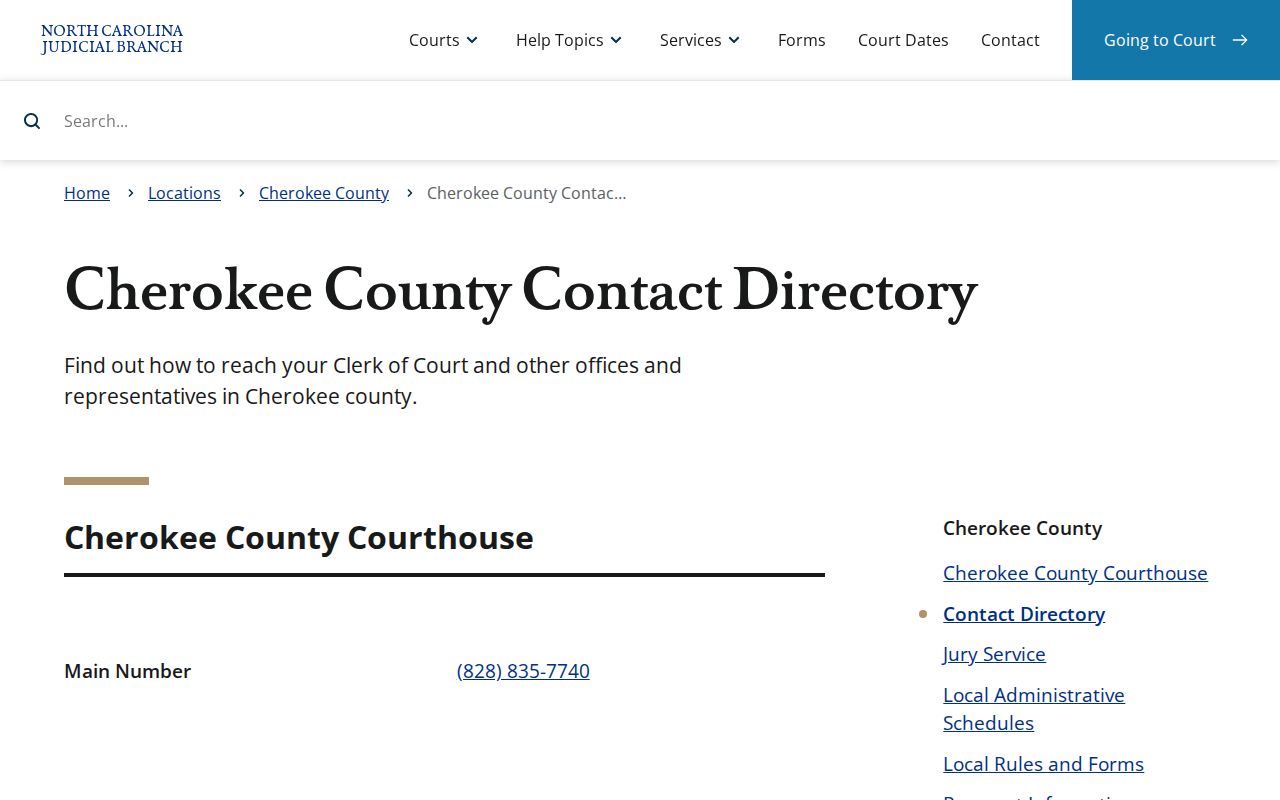
The directory separates court roles that can look similar in a docket: the clerk keeps records, the prosecutor represents the State, and magistrates handle specified judicial functions.
Cherokee County Case Record Searches
The free North Carolina eCourts Portal is the broad public starting point. No account is required for public data. Smart Search accepts names and several record identifiers, while Advanced Filters can narrow location, criminal case type, case status, and filing dates. The official Portal FAQ documents wildcard and data limits. Exact terms are best at first. Common names can return unrelated people, and a broad date range can hide the useful result in a long list.
- Open Smart Search and choose the search type that matches the known identifier.
- Enter an exact party name, case number, citation number, attorney, business, cross-reference number, or nickname.
- Set Location to Cherokee County, then add criminal case, status, and filing-date filters as needed.
- Open Case Summary and read Events, Dispositions, Hearings, and Judgment details as separate parts of the record.
- Ask the Cherokee County clerk for an official or certified copy when the result must be verified.
The core controls documented in official training are shown here. Some fields display only when that search mode or public record makes them available.
| Field or control | Type | Required | Use |
|---|---|---|---|
| Search criterion | Text | Yes | Party, record number, citation, attorney, business, cross-reference, or nickname |
| Search Type | Dropdown | Effectively | Selects the kind of identifier being entered |
| Location | Filter | No | Choose Cherokee County |
| Party criteria | Filters | No | Name and available birth-related criteria |
| Case Type and Status | Filters | No | Narrows criminal actions and open or disposed cases |
| Filing Date | Date range | No | Sets start and end dates |
Cherokee County eCourts Smart Search
North Carolina completed eCourts conversion in all 100 counties in October 2025. Official Portal training and resources explain Smart Search, Search Hearings, Judgment Search, and the result layout. The training image below shows the Cherokee County public system rather than a private person's record.
Case numbers need at least four characters before a wildcard. A person's last name needs at least three characters and the first name at least one before an asterisk. Business and nickname searches need at least four. Search exact terms first, then widen with a permitted wildcard. The public Portal view is free, but it is not the certified court record.
The captured official Smart Search page assigned to Cherokee County was flagged because its download was below the manifest's size threshold. It remains a source view of the portal, not proof that a result is complete.

Portal controls can change, so the live official interface should govern the search. A saved image cannot establish that a case is open, closed, sealed, or absent.
What a Criminal Case File Contains
A Cherokee County criminal case detail can organize the public record into Case Summary, Case Information, Assignment Information, Party Information, Case Events, Dispositions, Hearings, and Financial Information. Empty sections may not display. Victims are omitted from returned parties, and restricted identifiers do not become public merely because another part of the case can be seen.
| Case number and court | Identifies the action, court level, case type, status, and filing context. |
|---|---|
| Charging information | Shows filed counts or allegations, which may differ from the arrest label. |
| Parties and assignments | Lists public parties, attorneys, and available judicial assignment data. |
| Case events | Records docket activity and filings in sequence, not necessarily the final outcome. |
| Hearings | May show dates, courtroom, judicial official, and hearing status. |
| Disposition and judgment | Shows how each charge ended and any public judgment or sentence information. |
| Financial information | Lists available assessments or payment-related case entries. |
A Cherokee County Portal printout is a lead. The Judicial Branch instructions for obtaining court records route official searches and copies through the clerk. The clerk's copy is the official file, and a certified copy carries the clerk's formal certification.
When Cherokee County Search Finds Nothing
“No cases match” does not prove that no record exists. A name may be spelled another way, a filter may point to the wrong county, or the date and status choices may be too narrow. Older paper material may not be viewable online. Restricted, sealed, juvenile, and expunged matters are also outside ordinary public results. Start again with fewer filters, test a known case or citation number, and use the permitted wildcard rules only after exact attempts.
If a Cherokee County case still does not appear, call or visit the clerk. The public self-service terminal can search by defendant name, case number, or victim or witness name. Staff can locate older files, supply copies, and perform the county public-record name search for $25. That name search is court and county limited. It is not the fingerprint-based SBI Right to Review.
Criminal Case Stages in Cherokee County
A case does not become final when the arrest occurs. Charges enter the court system, the defendant appears, both sides address pretrial issues, and each count reaches a plea, trial, dismissal, or other disposition. Sentencing follows a conviction where required. North Carolina's felony punishment statute and misdemeanor punishment statute show why an offense class alone does not state the sentence. Felony proceedings may begin in District Court and later proceed in Superior Court, while misdemeanors are tried in District Court.
Case flow: Charges Filed › Arraignment › Pretrial › Plea or Trial › Disposition › Sentencing
The flow is a reading aid, not a promise that every case has every event. A dismissal can end a count before trial. A plea can replace a trial, and separate counts in one file can have different dispositions.
Reading Cherokee County Case Events
Events show what happened in the docket over time. Dispositions show how a charge ended. Treating an arraignment, hearing notice, or motion as the final result is a common error. Read each charge line and its disposition, then review the judgment for the sentence imposed after a conviction. “Dismissal” means termination without conviction; “acquittal” is a not-guilty determination; and “nolle prosequi” reflects a prosecutor's decision not to continue, with North Carolina records also using dismissal-with-leave concepts.
Cherokee County court dates are available through the local administrative schedules. The official schedule image below provides a route to local criminal and District Court calendars.
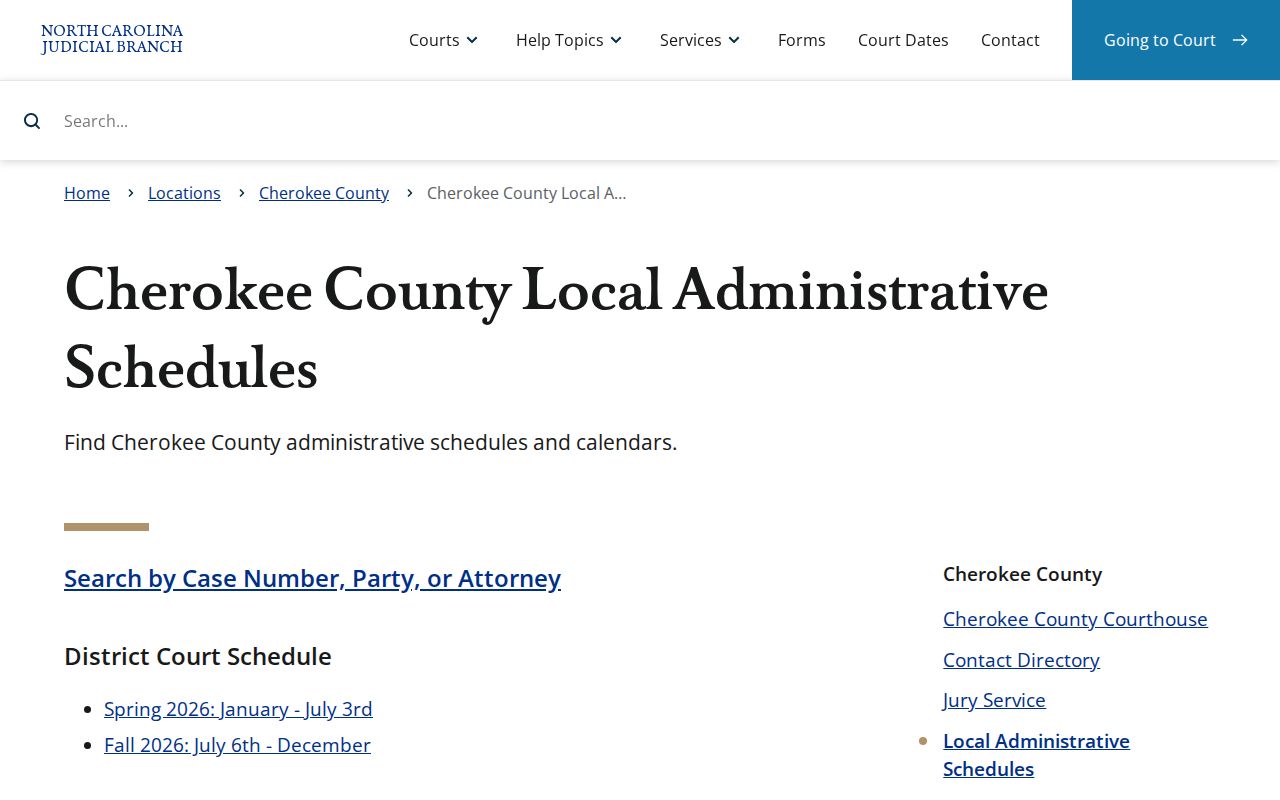
A calendar lists scheduled activity, not a final outcome. Recheck the docket after the hearing and use the clerk's file when the exact ruling matters.
Access Rules for Case Records
G.S. 7A-109 generally opens clerk records to inspection subject to law. That rule does not expose every item. Juvenile matters, sealed files, victim identities, sensitive personal identifiers, and expunged entries are not treated as ordinary public Portal material. Online redaction can also make the public screen narrower than an official paper file without making protected data available at the counter.
Returned arrest warrants, search warrants, indictments, and criminal summons are public under G.S. 132-1.4 unless sealed. Active investigative material and law-enforcement recordings follow different access rules. Ask the clerk which legal restriction applies when a file or document is withheld rather than assuming a portal error.
Cherokee County Clerk and Court Contacts
The Clerk of Superior Court is at 75 Peachtree Street, Murphy, NC 28906. Public hours are Monday through Friday, 8:00 a.m. to 12:30 p.m. and 1:30 to 5:00 p.m. The midday closure matters for a trip from the county's outlying areas. Call 828-835-7740 for the clerk. The courthouse is wheelchair accessible, but official sources do not publish detailed screening, phone, locker, or parking rules, so confirm those before travel.
Cherokee County Clerk
75 Peachtree Street
Murphy, NC 28906
828-835-7740
Weekdays, 8:00 a.m.-12:30 p.m. and 1:30-5:00 p.m.
District 43 Contacts
District Attorney: 828-835-7750
Magistrates: 828-835-7755
Superior Court judges: 828-369-7299
Direct record-copy and certification questions to the clerk. The District Attorney prosecutes cases and does not replace the clerk as custodian of the public court file. The Defender District 43 page identifies the public defender office serving Cherokee County, while the court payment page gives the separate official route for eligible case payments.